
Emergency Air Duct Cleaning Near Me: What Westminster Homeowners Should Do First
When something contaminates your ductwork, the first move most homeowners make is also the worst one: they crank the thermostat fan to “flush out” the smell. That single action pushes smoke residue, sewage particles, or rodent debris through every branch of the system before anyone has assessed where the contamination actually sits. Your ducts aren’t a chimney. Running the blower after a contamination event distributes particulate to rooms that were still clean. This guide covers the containment window before a crew arrives in Westminster.
If you’d rather not work through this alone, call us at (833) 736-5689. We answer 24/7. Fast dispatch from 7am to 7pm, Sunday through Friday.
Why You Should Shut Down the HVAC System First
The single most important thing you can do in any duct contamination emergency is turn the system off at both the thermostat and the breaker. Not just “fan to off” on the thermostat, but the actual breaker that feeds the air handler. If you’re not sure which breaker it is, look for the switch labeled for your furnace or HVAC unit on the panel. If it’s unclear, trip the main and call us.
Here’s why this matters. An HVAC blower is a small centrifugal fan that moves hundreds of cubic feet of air per minute. Every time it runs, it cycles air through the supply ducts, past the registers, into the rooms, back through the returns, and through the air handler. When a sewage backup, smoke event, or rodent infestation has contaminated any section of that loop, every cycle spreads it further.
- Sewage particles carry pathogens; air movement pushes them into bedrooms and kitchens.
- Fire and smoke residue coats duct interiors and can re-deposit as soot on soft furnishings.
- Rodent droppings and nesting material can break apart into respirable dust that settles into living areas.
- Mold colonies on wet ductwork release spores with every cycle.
Shutting down the system stops that. It’s the single cheapest damage-limiting step you can take, and it costs nothing. In our experience, the Westminster homes with the least contamination spread are the ones where the homeowner shut things down within the first hour.
How Do You Categorize Your Emergency by Contamination Type?
Duplicate your cleanup protocol for the wrong contamination type and you make the problem worse. Broadly, duct contamination falls into three categories, and each one requires a different remediation approach.
Biological: Sewage and Mold
Raw sewage backup into a basement floor drain or sump pit can wick into nearby duct runs. Mold can grow on duct liner or insulation when moisture sits in the system. Biological contamination needs sanitizing as part of the remediation, not just vacuuming. Professional sanitizing agents (Honeywell and Aprilaire products are common in this work) are calibrated for HVAC surfaces; the household spray bottle is not.
Particulate: Fire, Smoke, and Construction Dust
Fire and smoke contamination leaves soot on duct walls. Construction and renovation dust carries fine silica and debris. Particulate remediation is mostly about high-volume HEPA collection with agitation so the debris is loosened from the surface and captured, not just dislodged.
Pest: Rodent and Insect Infestation
Rodent activity in ductwork means droppings, urine, nesting fibers, and possibly carcasses. Insects like cockroaches and silverfish congregate in warm, dark duct runs. Pest contamination usually needs cleanup and sanitizing after the pest source is eliminated, in that order.
If you’re not sure which category you’re facing, describe what you see and smell when you call. That tells a trained technician more in 60 seconds than a website form will.
What Should You Photograph Before Cleaning Starts?
Take photos of everything contaminated, from the register covers to the visible duct interior to the source, before any cleaning crew touches the system. This documentation matters more than most Westminster homeowners expect: it’s evidence in an insurance claim, and once the ductwork is cleaned, the opportunity to document is gone.
- Register covers and grilles, inside and out
- Any visible duct interior you can see with a flashlight (do not open sealed ductwork)
- The source: the sewage backup area, the fire zone, or the rodent trail
- Ceiling and wall stains near returns and supplies
- Any damaged duct liner, exposed insulation, or collapsed flex duct
Photos of the duct interior before cleaning go a long way when an adjuster wants to see the scope. Many homeowners regret not taking them, because the cleaned ducts look “fine” afterward, and the claim gets harder to prove. If a technician is already en route, take the photos now while the contamination is still visible.
What Does a Basement Flood in a Westminster Tract Home Mean for Ductwork?
Westminster tract homes built through the 1980s and 1990s often run their floor-register ductwork through or just above the basement slab. A basement flood doesn’t have to submerge a duct to damage it; capillary wick into nearby insulation and duct liner can happen in a matter of hours, and it’s frequently invisible.
If you’ve had a basement flood, watch for these signals in the days after:
- A musty odor that appears when the heat or AC kicks on
- Condensation forming on register covers in rooms near the flooded area
- Visible sagging or staining on flex duct you can see from the basement
- Unexplained allergy symptoms that follow you from room to room
Wicking is a moisture problem before it’s a mold problem. The time-sensitive fix is drying the slab and ductwork fast, then having the ducts inspected for moisture and cleaned if necessary. If your ducts were within a few feet of the floodwater line, get them assessed. This is one of the Westminster-specific calls we get after storm season, and it’s usually a whole-system cleaning rather than a spot fix.
What Questions Should You Ask an Emergency Duct Cleaning Company?
A standard cleaning crew that agrees to rush a job for you is not the same as a crew equipped for remediation. Ask these questions before you book anyone, and listen for specific answers rather than reassurances.
- “What containment equipment will you bring?” Remediation-grade jobs use negative-air containment (Abatement Technologies units are a common example) so dislodged contaminants are captured and filtered, not just pulled into a shop vac.
- “What vacuum standard do you use?” Nikro HEPA units or Rotobrush agitation systems indicate a crew used to professional jobs. A shop vac and a brush is a warning sign.
- “What’s the sequence for my contamination type?” Sewage is cleaned and sanitized; fire is agitated and HEPA’d; pest is cleaned after the source is eliminated. Vague answers are a red flag.
- “Do you repair and seal ducts, or only clean them?” If the ductwork is damaged, cleaning it without sealing it leaves a leak. Ask whether they handle the integrity side too.
- “Will I get before-and-after photos of my own ducts?” Real remediation crews document their work. A cleaning company that doesn’t can’t prove anything after they leave.
- “Is the price flat per system or per vent?” Flat per system, agreed in writing before work starts, is what you want.
When to Call a Pro
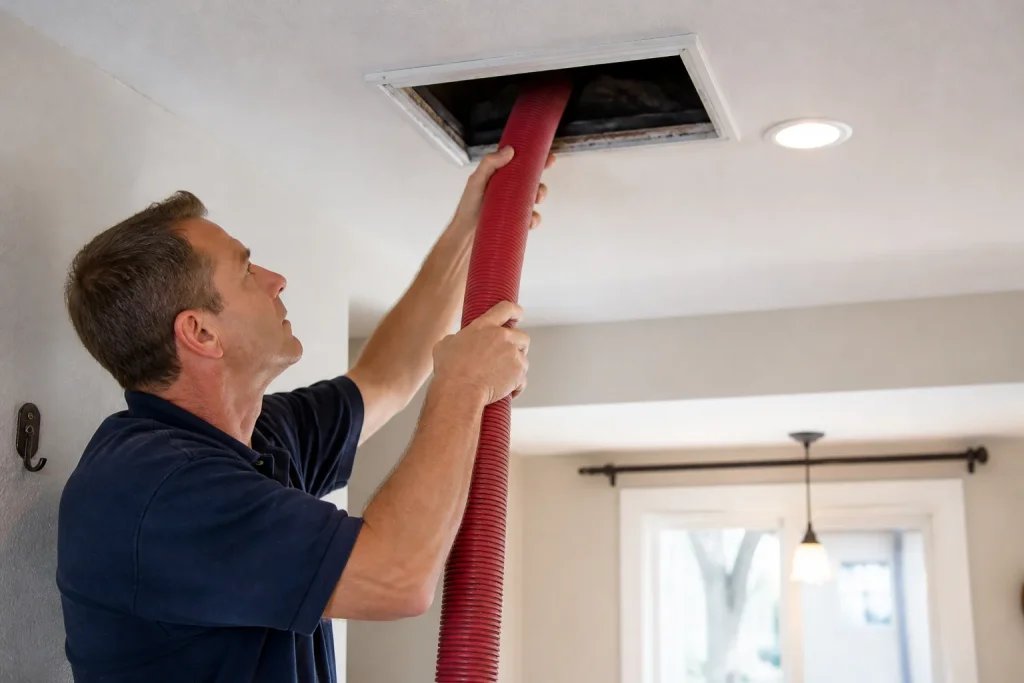
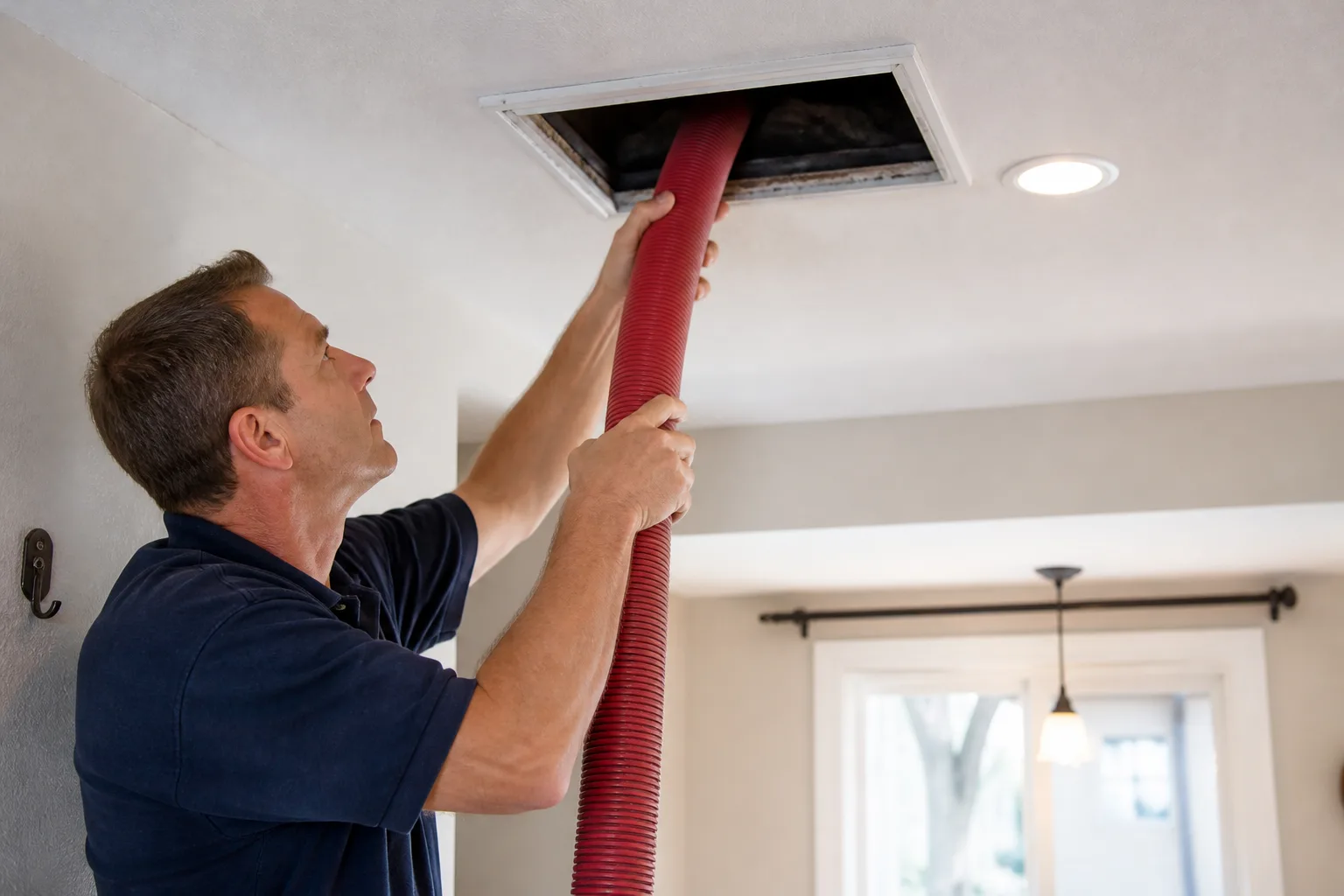
You should call a professional duct cleaning company any time contamination is biological, involves fire or smoke residue, or comes from rodents; those aren’t situations where DIY vacuuming is a safe option. Shutting the HVAC down at the breaker is a homeowner step. Anything past that, cleaning duct interiors with the wrong equipment spreads the problem. Call (833) 736-5689 and describe what you’re seeing.
When we send a technician, we use professional-grade equipment rather than hardware-store substitutes. That means Rotobrush agitation to loosen debris from duct walls, Nikro HEPA unit collection, and Abatement Technologies negative-air containment so what gets loosened stays contained. For biological contamination, we bring Honeywell and Aprilaire-grade sanitizing products into the plan.
Related services in Westminster: air duct cleaning, dryer vent cleaning, and HVAC cleaning all belong to the same family of indoor-air work. If you’re dealing with any of them, we can likely handle it in a single visit.
The Bottom Line
In a duct contamination emergency, the sequence is: shut down the HVAC at the thermostat and the breaker, categorize the contamination (biological, particulate, or pest), photograph everything visible, and then call a crew that can prove containment capability. Do those four things in order and you’re limiting the damage rather than spreading it. Skip the thermostat and blower step, and everything else gets harder.
If you’re in Westminster and need help, Westminster Air Duct Cleaning Pros offers free estimates. Call (833) 736-5689. We answer 24/7, with fast dispatch from 7am to 7pm, Sunday through Friday. The local professional sent to your home is licensed and insured as their state requires, and the price is one flat rate per system agreed before work starts, with before-and-after photos of your own ducts.
Frequently Asked Questions
No. Running the HVAC fan after a contamination event distributes the contaminants through every room connected to the system. For biological, fire, or pest contamination, shutdown is the correct first move. Call (833) 736-5689 if you’re unsure what category you’re dealing with.
Whole-system cleaning is priced per system, not per vent, and the written estimate sets the final price. A bait-and-switch quote that starts very low and balloons on-site is the industry trap to watch for; ask for a flat, written price before work begins. Call (833) 736-5689 for a free estimate.
Cheaper quotes usually reflect a shop vac and a brush instead of commercial-grade equipment. Real remediation work uses HEPA collection, agitation, and negative-air containment, and that equipment costs money to own and operate. The lowest price and the right equipment rarely describe the same company. Call (833) 736-5689 and we’ll walk you through what the job actually needs.
Possibly, yes. Duct liner and insulation can wick moisture from a wet slab long after the surface water is gone, and mold can grow before you smell it. Have the ducts inspected if your floor registers were within a few feet of the flood line. Call (833) 736-5689 to schedule an assessment.
You can also read more about our team and services at Westminster Air Duct Cleaning Pros.
Written by the team at Westminster Air Duct Cleaning Pros.
Need Air Duct Cleaning Help?
Call Westminster Air Duct Cleaning Pros - the local pro we connect you with is licensed and insured, here with fast help in Westminster.
(833) 736-5689